Mic Always Hot: How We Learned to Document Everything and Forgot How to Just Talk
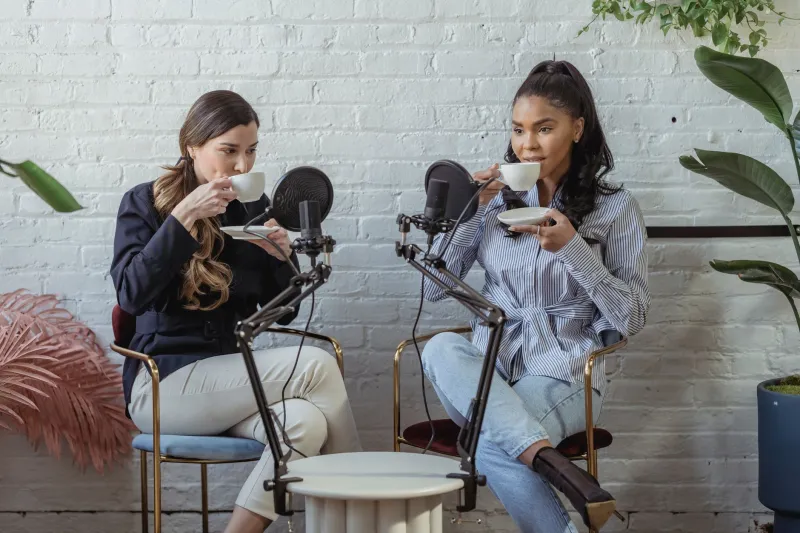
There's a moment most podcast listeners know but rarely name. It's that slight shift in energy when a guest realizes the recording has started. The posture straightens. The laugh gets a little more deliberate. The pauses — those honest, fumbling pauses where a real person is genuinely thinking — start to disappear. What was a conversation becomes a performance. And we've all been trained, slowly, to do the same thing in our own lives.
We didn't mean for it to happen this way. The explosion of audio content over the last decade was supposed to democratize storytelling. Anyone with a USB mic and a Squarespace account could suddenly be a broadcaster. Real people, real stories, no gatekeepers. That was the promise. And in a lot of ways, it delivered. But something else came along for the ride — a low-grade awareness that anything said out loud might end up somewhere. On a feed, in a screenshot, in a clip. And that awareness has quietly rewired the way we talk to each other.
The Phantom Mic Effect
You don't need an actual recording device for this to kick in. Psychologists have documented what happens when people believe they're being observed — they conform, they self-edit, they perform a version of themselves they think will land better with an audience. Now scale that up to a culture where everyone has a podcast, a TikTok, a voice memo app, and a best friend who might tweet what you just said. The phantom mic is always there.
This isn't just paranoia. It's rational adaptation. People have lost jobs over dinner table conversations. Friendships have ended over things said in what felt like a safe room. The lesson most of us absorbed, consciously or not, is that there's no such thing as off the record anymore. So we started pre-editing ourselves. We started treating every conversation like a potential deposition.
The result is a culture of dialogue that's technically more documented than any in human history — and somehow shallower for it.
Content Brain and the Death of the Aside
Here's something that doesn't get talked about enough in the podcast world: the aside. The throwaway comment. The half-formed thought you say to someone you trust because you're still working it out. Those little conversational scraps are where a lot of the most honest human exchange actually lives. They're not polished. They're not quotable. They're barely coherent sometimes. But they're real.
Content brain — the habit of mentally framing your life as potential material — has a tendency to kill the aside. When you're always thinking about how something might sound in a clip, you stop saying the things that don't clip well. Which is most of the interesting stuff. The contradictions, the admissions, the "I don't know, I've been thinking about this and I'm not sure" moments. Those get edited out before they even make it past your teeth.
This is a real loss. Not just for podcasts, not just for media — for the actual texture of human relationships. Because the aside is often where intimacy lives. It's the stuff you only say to someone you're genuinely comfortable with. When we stop doing it, we stop getting close.
The Recording Booth We Built Around Ourselves
Spend time around people who make audio for a living and you'll notice something interesting: a lot of them are genuinely terrible at unstructured conversation. Not all of them, not even most — but enough that it stands out. The best interviewers in the business will tell you that the craft is partly about learning to turn off the producer brain and actually listen. That's not easy when you've spent years treating conversation as raw material.
But it's not just professionals. Regular people who grew up posting, sharing, and documenting are developing the same tic. Every experience gets mentally filed as story or not-story before it's even finished happening. Every interesting thing a friend says gets internally tagged as "I should tell people about this." We're so busy archiving our lives that we're starting to miss them.
There's a version of this that's harmless — even charming. The person who's always got an anecdote, who processes the world through narrative. But there's another version that's lonelier. Where the documentation impulse becomes a buffer between you and whatever's actually happening. Where being present feels like wasted bandwidth because nothing's being captured.
What Unmediated Conversation Even Feels Like Anymore
Ask someone to describe their last genuinely unguarded conversation. The kind where you forgot to be careful. Most people have to think for a while. Some can't come up with one.
That's worth sitting with.
The conversations that actually change us — that shift something in how we see the world or ourselves — almost never happen on the record. They happen at the end of a long drive when everyone's tired and the defenses are down. They happen at kitchen tables at 1am. They happen when nobody thought to pull out a phone. There's a reason the best podcast hosts will tell you the real conversation started after the mics went off. It's not a coincidence. It's cause and effect.
The irony is brutal: an entire industry built on the premise that authentic conversation is worth listening to has made authentic conversation harder to have. We've gotten so good at performing openness that we've forgotten what actual openness feels like. We've confused vulnerability-as-content with vulnerability-as-experience. They are not the same thing.
Getting Back to Just Talking
None of this is an argument against podcasts. Obviously. But it is an argument for protecting something that the podcast boom accidentally put at risk: the private conversation. The one that doesn't go anywhere. The one where you say something half-baked and your friend pushes back and you end up somewhere neither of you expected. That process — messy, unarchived, unmonetized — is actually how people figure things out together.
Maybe the most radical thing you can do right now is have a conversation you're not going to tell anyone about. No recap, no hot take, no episode pitch. Just two people talking until they run out of things to say, and then sitting in that silence for a second, and then maybe saying the thing they actually meant to say all along.
That's the conversation graveyard we should be worried about. Not the ones we stopped recording — the ones we stopped having.