Dead Air Isn't Dead: What Happens When Nobody Rushes to Fill the Silence

There's a moment in almost every great interview — you've probably felt it if you've listened to enough long-form podcasts or watched a really sharp journalist at work — where everything stops. The guest finishes a sentence. The host doesn't immediately respond. And for two, maybe three full seconds, there's just... nothing.
Most people in that chair panic. They backpedal. They add qualifiers, walk back what they just said, or pivot to something safer. And in doing so, they often give you the most honest thing they've said all conversation.
That moment — that gap — is not an accident. It's a technique. And the people who've mastered it are doing something that feels almost counterintuitive in an era where content is measured in seconds and dead air is treated like a production mistake.
The Radio Brain Problem
We've been trained, culturally and professionally, to treat silence as a problem to be solved. Talk radio hammered this into the American media psyche for decades. Dead air costs money. Dead air loses listeners. Dead air means something went wrong in the booth.
But that framing has bled way beyond broadcasting. It's infected dinner tables, therapy waiting rooms, job interviews, first dates, and — critically — the kinds of long-form conversations that are supposed to get at something real. We've become so conditioned to treat quiet as a void that needs filling that we've essentially trained ourselves out of one of the most powerful communication tools humans have ever had.
The irony is that silence, in the right context, isn't empty at all. It's loaded.
What Therapists Have Known Forever
Ask any licensed therapist or clinical psychologist about strategic silence and they'll look at you like you just discovered gravity. This isn't new territory in mental health settings. Allowing a pause to breathe — what practitioners sometimes call "sitting with" a moment — is a foundational technique in everything from cognitive behavioral therapy to narrative therapy.
The psychology behind it isn't complicated, but it is fascinating. When a conversation stops and no one rushes in, the human brain experiences a low-grade discomfort. We're social animals. Silence in the presence of another person feels, at a neurological level, like something is unresolved. And because we're wired to resolve things, we talk. We explain. We elaborate.
And that elaboration? That's often where the truth lives.
It's not manipulation — or at least it doesn't have to be. It's more like... creating the conditions for honesty. You're not tricking someone into saying something they don't mean. You're giving them enough space to say something they actually do mean, which is a very different thing.
How the Best Hosts Actually Use It
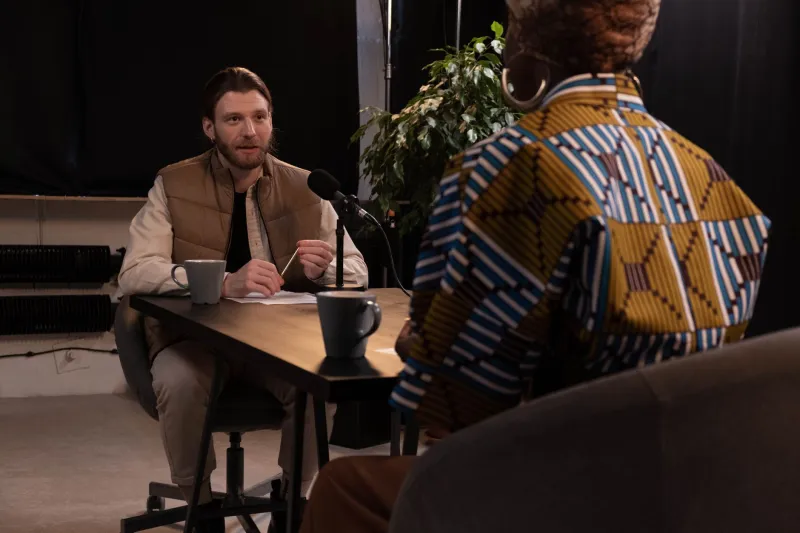
If you listen closely to the long-form podcast interviews that really stick with you — the ones where a guest says something that surprises even them — you'll almost always find a host who knows how to get quiet at the right moment.
It's not passive. That's the part people miss. Strategic silence is an active choice. It requires the host to suppress every instinct telling them to nod, affirm, redirect, or move on to the next question. It requires genuine comfort with discomfort, which is genuinely hard to develop when you're also managing a microphone, a recording schedule, and the knowledge that thousands of people are going to listen to this later.
Producers who work in long-form audio talk about this in terms of "space" — not just sonic space in the edit, but conversational space in the room. The hosts who create the most memorable interviews tend to be the ones who treat a guest's trailing sentence not as a cue to jump in, but as an open door. They wait to see if the guest walks through it themselves.
Sometimes they don't. Sometimes the moment passes and you move on. But sometimes — and this is what keeps people in the business — the guest walks through that door and ends up somewhere neither of them expected to go.
The Discomfort Is the Point
Here's the thing that's hard to explain to someone who hasn't experienced it from either side of the microphone: the discomfort of a held pause is not a side effect. It's the mechanism.
When you're a guest and the host doesn't immediately respond to something you've said, your brain starts auditing. Did I say that right? Was that too much? Should I clarify? And in the process of that audit, you often end up going deeper than you planned. You find the more accurate version of the thing you were trying to say. You drop the PR-approved phrasing and reach for the real one.
Journalists who cover high-stakes interviews — political reporters, investigative journalists — describe something similar. A source who's been carefully managed and media-trained for years will sometimes crack open, just slightly, in the silence after a question. Not because they've been tricked, but because the absence of follow-up pressure gave them room to reconsider the wall they'd put up.
That's a skill. And like most real skills, it's not glamorous. It doesn't look impressive in the moment. It just works.
Why We've Gotten Worse at This
Social media and short-form content have made us measurably worse at tolerating ambiguity and delay. Research on attention spans and digital communication habits consistently shows that Americans are getting less comfortable with open-ended, unresolved conversational moments. We want the answer, the punchline, the takeaway — and we want it before the discomfort has a chance to settle in.
Podcast culture, despite producing some genuinely extraordinary long-form content, has also developed its own nervous habits. The filler word epidemic is real. "Totally," "for sure," "a hundred percent" — these affirmations have become reflexive, and they're doing more than just filling air. They're signaling to the guest that they don't need to go any further. They're closing doors that good silence would leave open.
The best hosts catch themselves doing this. The ones who don't tend to produce interviews that are pleasant but forgettable.
Sitting With It
There's something almost meditative about a well-held pause in conversation, and it's not a coincidence that the cultures and traditions that most value deep listening tend to also have a different relationship with silence than mainstream American media does.
The goal at Untenrumpo has always been the conversation that goes somewhere real — not just the conversation that sounds good in a thirty-second clip. And getting somewhere real almost always requires passing through a moment that feels, briefly, like nothing is happening.
That nothing is doing a lot of work.
Next time you're listening to an interview and someone doesn't immediately fill the gap, don't reach for the skip button. Wait. See what comes out of it. Odds are, that's the part of the conversation worth staying for.