Hold the Beat: What Silence Actually Sounds Like When Nobody's Rushing to Fill It

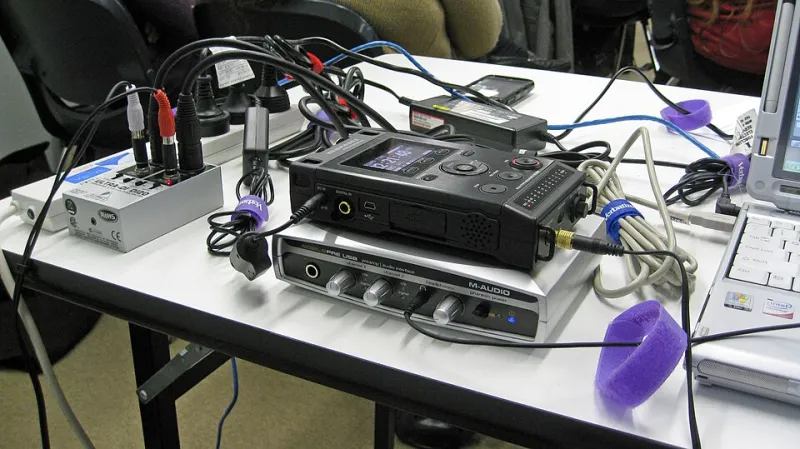
Photo: NPS, Public domain, via Wikimedia Commons
There's a moment in a great interview — and if you've listened to enough of them, you know exactly what it feels like — where someone says something heavy, something true, and then just... stops. And instead of the host jumping in with a follow-up or a transition, there's nothing. Just air. Just the faint hiss of a recording studio or the ambient hum of a living room.
That moment, uncomfortable as it is, is usually where the conversation actually begins.
We don't get enough of those moments anymore. And that's worth talking about.
The War on Quiet
American media — and really, American culture broadly — has developed a near-pathological relationship with noise. Turn on cable news and you'll find four people talking over each other about something that happened twelve minutes ago. Scroll through short-form video and you'll notice that even the pauses have been edited out, replaced with jump cuts and overlaid text so nobody has to sit with a thought for more than two seconds.
Podcasting was supposed to be different. And in its best form, it still is. But as the medium has grown into a legitimate industry — with ad rates, download metrics, and listener retention dashboards — a certain kind of anxious efficiency has crept in. Hosts are coached to keep energy high. Editors are told to cut anything that feels slow. The result is content that's technically smooth but emotionally shallow.
When everything moves at the same pace, nothing lands with any particular weight.
Why Silence Freaks Us Out
The psychology here isn't complicated, but it is fascinating. Research on conversational dynamics — including work done by Dutch psychologist Namkje Koudenburg — has shown that even a silence of about four seconds in a group conversation is enough to trigger feelings of rejection and social threat. Our brains are wired to interpret quiet as a signal that something has gone wrong.
In a media context, that instinct gets amplified. Broadcasters have used the phrase "dead air" for decades — dead, as in something has died, as in failure. That framing has seeped into how podcasters think about their own work, even when the format is completely different. A long-form audio essay or a sit-down interview isn't live radio. The stakes of a three-second pause are exactly zero. But the anxiety feels real anyway.
Here's the thing though: that discomfort? It's actually useful. A well-placed pause doesn't just give the guest time to think. It signals to them — and to the listener — that the host isn't rushing. That the answer matters more than the momentum. That this is a space where incomplete thoughts are allowed to finish themselves.
What the Greats Actually Do
Terry Gross has been hosting Fresh Air since 1975. If you've listened to her work, you've probably noticed that she doesn't panic. When a guest trails off, she waits. When something surprising gets said, she doesn't immediately pivot to her next question. She sits in it. Sometimes she just says "hm" and lets the guest keep going.
That's not accidental. That's craft.
Long-form podcasters in the mold of On Being's Krista Tippett or the late-career work of Marc Maron operate similarly. The silence isn't dead air. It's pressure — the kind that makes people say the thing they weren't planning to say. Anyone who's ever been in therapy knows exactly how this works. A good therapist doesn't rush to fill the space. They let you fill it, and what comes out is usually more honest than what you'd planned to offer.
Podcasters who've internalized this describe it as one of the hardest skills to develop, precisely because it cuts against every instinct you've built up from consuming fast media. You have to actively resist the urge to help. To rescue. To move things along.
"The silence is information," one audio producer who works in documentary storytelling put it. "If someone goes quiet after you ask them something, that quiet is telling you something. Maybe they're emotional. Maybe they're calculating. Maybe they're surprised by the question. Any of those things is interesting. Why would you cut it off?"
The Listener's Side of the Equation
Here's what gets overlooked in conversations about pacing: listeners need the pause too.
When you're driving or doing dishes or running and something genuinely stops you — a line that's unexpectedly honest, a story that hits close — you need a beat to absorb it. If the host immediately barrels into the next question, you've already missed it. You're catching up while the conversation has moved on.
Some of the most memorable podcast moments aren't the big revelations. They're the silences after the big revelations. The breath. The pause that tells you: yeah, we all just heard that.
In an era of relentless content, that kind of shared stillness is almost radical.
Reclaiming the Pause
None of this is an argument for dead air in the literal sense — nobody wants to listen to a host fumbling through notes for forty-five seconds. The pause has to be intentional. It has to feel held, not lost.
But the broader point stands: if we want conversations that actually go somewhere — that surface something true, that leave listeners with a thought they're still chewing on three days later — we have to stop treating silence like a problem to be solved.
The best long-form audio out there right now understands this. It's not about filling every second. It's about knowing which seconds to leave open.
Sometimes the most important thing a host can do is absolutely nothing.
And let the silence do the work.